What to Wear
T-Shirt Under Blazer for Men: When It Works and How
When a t-shirt under a blazer works for men: the three tee tests, the right blazer, and the outfit around it that keeps the look sharp, not sloppy.
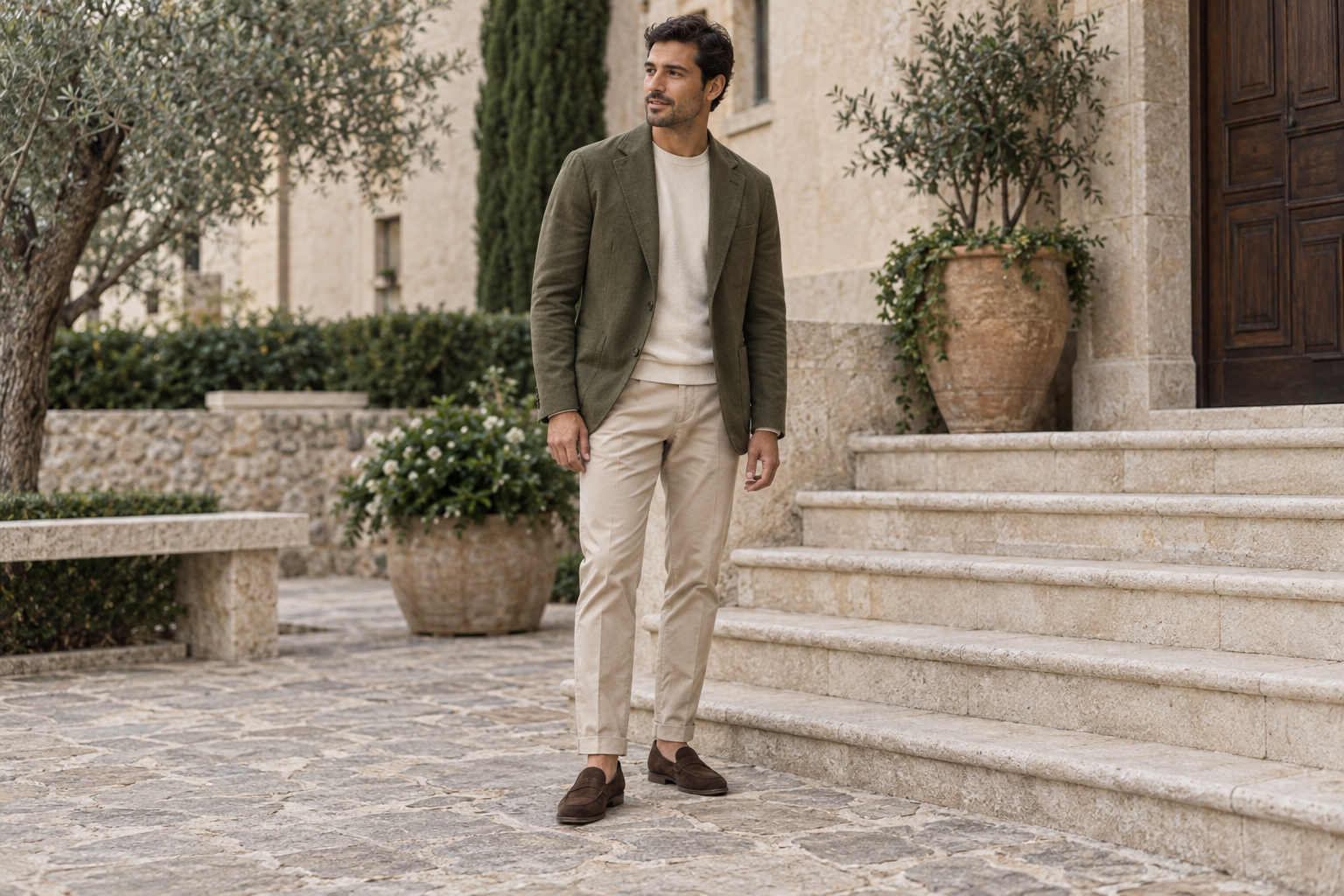
Dress code question
A blazer is optional at smart casual level — but going without only works when something else gives the outfit its structure. Here is the setting-by-setting answer, the three substitutes, and the rooms where a jacket still matters.
Begin hereDefinition / explainer
No — smart casual does not require a blazer. What it requires is a top half with some structure: a collared shirt, a knit shirt, or fine knitwear doing the job the jacket would otherwise do. The real question is not whether blazers are allowed off, but which settings expect one anyway.
The question comes up in wedding group chats and new-job threads constantly, and the honest answer is: the blazer is optional, but the structure is not. Smart casual sits below business dress precisely so a jacket can come off — provided a collared shirt, knit shirt or fine knit replaces the visual anchor it leaves behind.
When a blazer IS effectively required: dressier weddings, upscale restaurants, and any client-facing work role. In those rooms, jacket-free needs a serious substitute to pass — and even then it is a calculated risk, not a default.
Which level applies? Read the venue, the invitation wording and the guest list. A marquee wedding and a city restaurant with linen tablecloths are telling you different things even when both say smart casual. If you genuinely cannot tell, one polite line to the host or whoever is attending with you settles it: asking what they plan to wear sounds like conversation, not cluelessness.
| Setting | Blazer verdict | No-blazer outfit that still passes |
|---|---|---|
| Wedding guest (evening, city venue) | Required in practice | Dark fine knit, dress trousers, Chelsea boots — riskier than a jacket |
| Wedding guest (daytime, relaxed venue) | Optional | Oxford shirt, dark chinos or dark jeans, derbies |
| Smart restaurant | Optional, lean yes | Knit shirt, dark trousers, loafers |
| Office smart casual | Not needed | Shirt or fine knit, chinos, clean leather shoes |
| Pub dinner | Not needed | Polo or Oxford shirt, dark jeans, suede shoes |
| Date night | Not needed | Knitted polo, dark trousers, loafers — texture over structure |
| House party | Not needed | Overshirt over a plain tee, dark jeans, clean sneakers |
Every substitute works for the same reason: the structure or knit texture replaces the jacket's visual anchor, so the outfit reads deliberate rather than unfinished.
The overshirt and the structured cardigan deserve a mention as legal third pieces. A wool overshirt over a plain tee works anywhere at the relaxed-to-standard levels, and the chore jacket outfits guide shows the shape family in action. A structured cardigan counts too, but only when it fits close and reads planned, not stretched.
Both have limits: the dressiest rooms still want a true jacket. Colour rule for substitutes: quieter than the trousers, never busier.
If you own a suit, the suit jacket often solves this alone — worn with different trousers it reads as a blazer, which is the whole trick in the suit jacket as a blazer guide. A blazer on top of separates is genuinely expected at formal evening weddings and at weddings where you are in the wedding party.
Read the invitation like a signal, not a formality: plain smart casual means optional; jacket preferred means exactly what it says. Check the venue's own photo gallery or ask someone who attended the same venue before — five minutes of recon beats an evening of worrying. And the fallback rule: if the suit jacket feels too stiff, a fine knit underneath it beats going without entirely.
In your first week, watch what seniority wears, not what the policy says. The tell is jackets hanging on chairs while nobody actually wears one — that is a standard-level floor where the jacket is your insurance, not your uniform.
The compromise piece is an unstructured knit blazer or overshirt that lives at the office and goes on for meetings. Client-facing days change the default: when outsiders are in the room, the jacket goes on regardless of floor culture. If you are building the work wardrobe from scratch, the formulas in the men's outfit formulas guide show where the jacket slots in and where it is dead weight.
No-blazer outfits fail on sloppiness, not on the missing jacket. Same shirt, same trousers: pressed with clean shoes passes; creased with scuffed shoes fails. That is the entire difference.
Is it OK to not wear a blazer to smart casual? Yes — the code was practically designed for it. Match the substitute to the setting using the table above and you are dressed correctly, not marginally.
What replaces a blazer in a smart casual outfit? A structured collared shirt, a knit shirt, fine knitwear, a wool overshirt or a close-fitting structured cardigan — anything that gives the top half a deliberate anchor.
Do women need a blazer for smart casual? The same logic applies — structure over sloppiness — but the detail lives on the women's no-blazer guide, since the substitutes and silhouettes differ.
Is it better to be the only one in a blazer or the only one without? The only one in a blazer, comfortably — you can take it off and hang it over a chair, which reads as calibration. Being the only one without reads as a decision you cannot undo.
Smart casual for men does not require a blazer. A structured collared shirt, a knit shirt, or fine knitwear can carry the outfit instead. A blazer is effectively expected only at dressier weddings, upscale restaurants and client-facing work settings — and when in doubt, wearing one is the cheaper mistake.
What to Wear
When a t-shirt under a blazer works for men: the three tee tests, the right blazer, and the outfit around it that keeps the look sharp, not sloppy.
What to Wear
Men's knitwear for smart casual: the merino crew as default, the roll-neck for winter dinners, the cardigan as blazer substitute, and the v-neck verdict.
What to Wear
Smart casual shorts for men, solved: the tailored-short spec, the polo pairings that pass, shoes that work in heat, and the settings where shorts never do.